


Where Protective Gear Meets Collar Architecture
Fencing masks are not obvious muse material. They are designed for protection, built from hexagonal steel mesh stretched over a rigid bib that guards the throat and chin. That bib – stiff, curved, structurally specific – has spent decades in the sport, absorbing impact and largely ignoring fashion. Right now, however, designers working in structured tailoring and avant-garde shirting are studying that bib with unusual attention, tracing its seam lines and borrowing its geometry for collar construction that sits differently than anything produced through conventional pattern-making.
The movement is subtle enough that it has not generated runway press releases or brand campaigns. It is showing up instead in small-batch collections, bespoke tailoring studios, and the kind of fashion-forward workwear labels that treat garment engineering as the central design act. The fencing bib’s influence is arriving not as costume or literal reference, but as structural logic – a set of seam placements and curvature principles that make collar stands behave in ways that conventional methods have never quite achieved.

The Engineering Behind the Bib
To understand why the fencing mask bib translates so productively into collar design, it helps to look at what that bib actually does mechanically. It maintains a rigid curve that wraps from jawline to collarbone without collapsing under pressure. That curve is held not by the material alone but by a series of seams that distribute tension across multiple panels, keeping the structure intact regardless of movement or force. The seam placement is not decorative – it is entirely functional, and that function is exactly what structured collar stands have historically struggled to replicate through single-piece cutting.
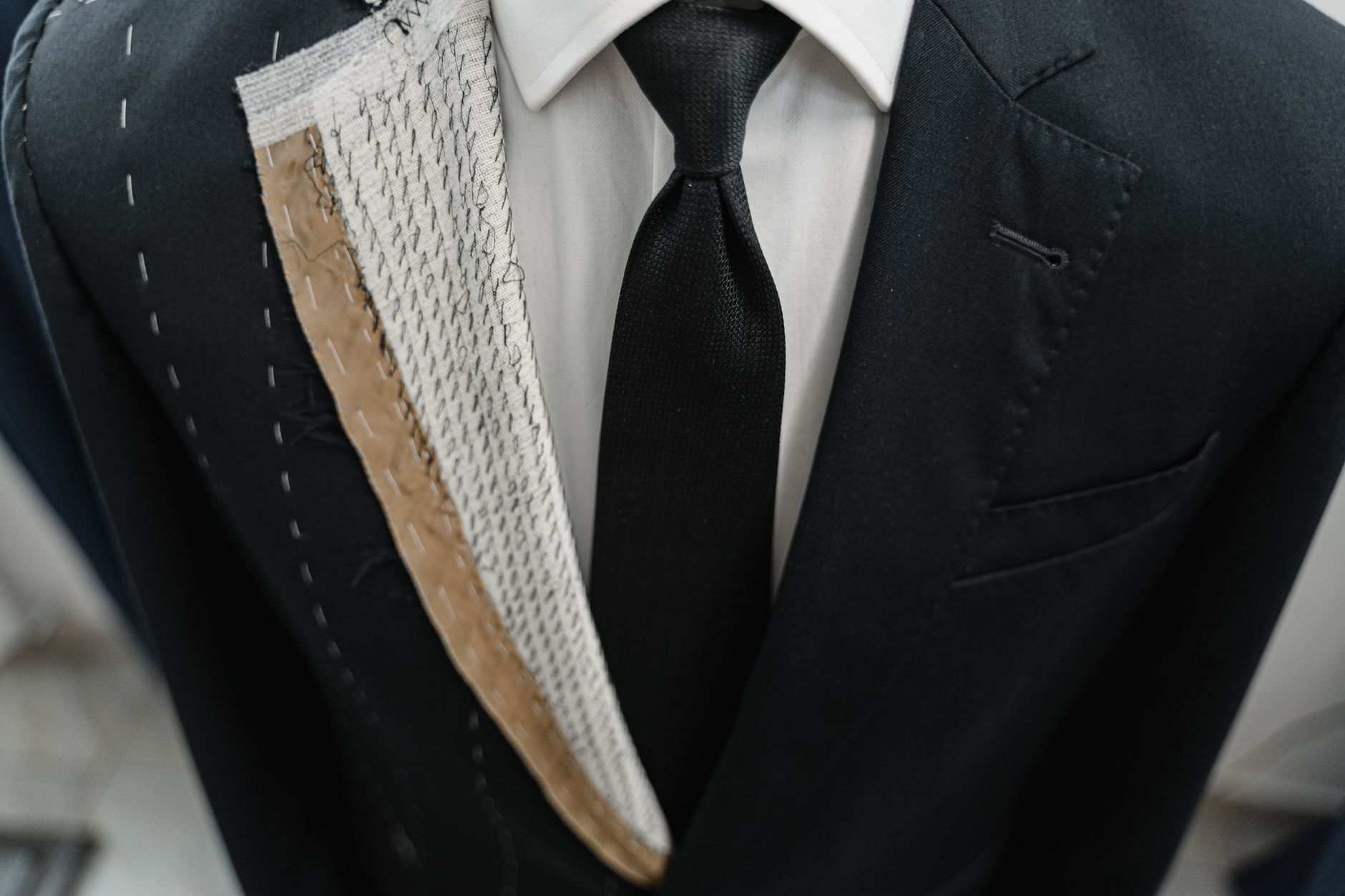
Standard collar stands are cut from one or two pieces of fabric, often interfaced heavily to achieve stiffness. The result holds a shape, but it is a static shape – one that can wilt at the pressure points where the collar folds, particularly at the sides of the throat where fabric wants to collapse inward. The fencing bib’s multi-panel seaming solves this by essentially building a load-bearing skeleton into the form itself. When pattern-makers translate that logic into collar construction, the stand gains the ability to hold its curve through a full day of wear without the deadening rigidity that heavy interfacing produces.
Seam Placement as Design Language
What is happening in practice is a reappraisal of where collar stand seams can live. Conventional construction places them at the back of the stand and along the collar attachment line – functional positions that prioritize invisibility. The fencing bib approach introduces seams along the lateral curve, following the jaw’s natural contour. These seams become visible design elements on the finished garment, creating a subtle topographic quality at the neckline – lines that read as intentional architecture rather than construction necessity.
Some designers working with this approach are pairing it with the kind of metallic weave technology explored in fencing lame fabric, which shares the same sport-to-fashion lineage. The combination of lame’s reflective surface with the bib’s seam geometry produces collar stands that read as almost armor-like – a quality that sits well in the current appetite for fashion that communicates structural intention without resorting to literal hardware or exaggerated silhouette.
The practical advantages compound beyond aesthetics. A collar stand built with distributed seaming requires less interfacing to maintain its shape, which means the garment moves more naturally through the day. It also ages differently – where a heavily interfaced stand can bubble and separate at the attachment points after repeated washing, a seam-supported structure holds its geometry because the shape is built into the cut rather than reinforced by a layer of adhesive material. For shirtmakers and tailors whose clients wear structured collars daily, this is a genuinely useful shift in construction method.
The silhouette consequence is worth examining closely. When a collar stand holds its curve through seaming rather than stiffening, it lifts slightly away from the neck at the throat, creating a small but visible gap between skin and fabric. That gap is where the architectural quality lives. It gives the collar a sculptural presence at close range – the kind of detail that reads as considered craftsmanship in a business context and as deliberate design statement in an editorial one. The collar does not announce itself loudly. It simply sits with unusual confidence.

Who Is Picking This Up and Why Now
The designers gravitating toward this approach tend to share a background in either sportswear engineering or historical tailoring – two fields that have always treated structure as the primary design variable. A growing number of independent shirtmakers in London, Tokyo, and New York are experimenting with multi-panel collar construction drawn explicitly from protective equipment patterns, citing fencing gear alongside motorcycle collar forms and equestrian helmet linings as source material. The common thread is gear built to protect a curved surface under dynamic conditions.
The timing connects to a broader appetite for garments that reward close inspection. Fashion has spent several seasons oscillating between maximalist surface decoration and strict minimalism, and structured tailoring has found a third path – pieces that look restrained at a distance but reveal engineering complexity up close. The fencing bib collar stand fits that sensibility precisely. It does not shout. It holds.
There is also a craft conversation happening around this technique that extends beyond the garment itself. When pattern-makers develop multi-panel collar stands, they are working with significantly more complex construction than conventional shirtmaking demands – more pieces, more precise seam alignment, more skill required at the sewing stage. That complexity has value in a market increasingly interested in distinguishing between garments that merely look tailored and garments that are, in structural terms, genuinely engineered. The fencing mask bib, stripped of its mesh and its sport context, turns out to be a surprisingly sophisticated template for that distinction.
Whether this technique crosses into mainstream tailoring or remains a tool of small-batch specialists may depend less on trend momentum and more on whether the construction complexity can be adapted for production scale. Right now, the seam-supported collar stand is a detail that separates the makers willing to cut seven panels from those cutting two.