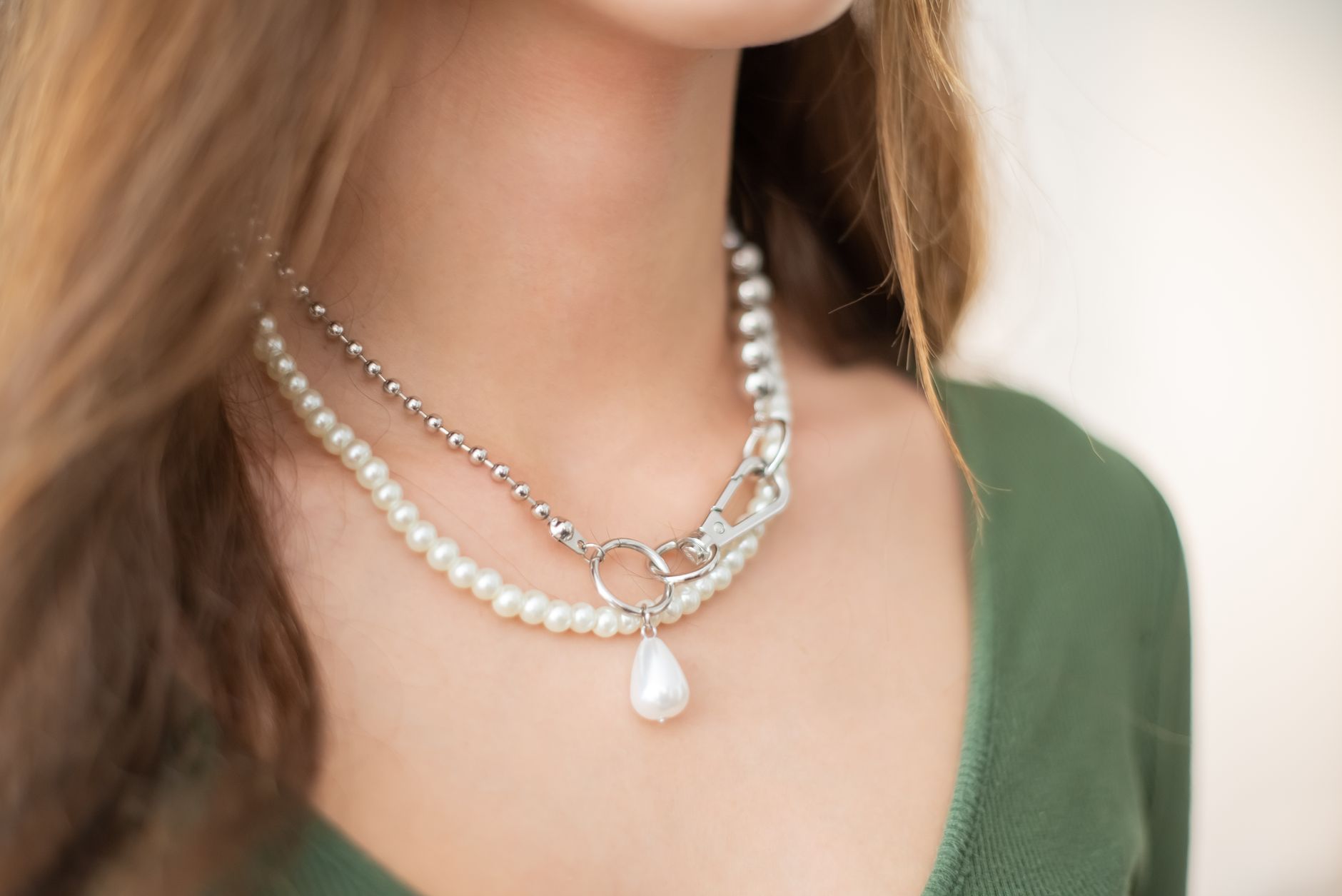


The Equestrian Hardware Making Its Way to High Fashion Necklines
The martingale neck strap loop is a narrow, reinforced ring or D-ring fitting threaded onto the neck strap of a polo club martingale – a piece of tack designed to control a horse’s head carriage and prevent it from throwing its head back. It is strictly functional, built to withstand force and repetition, and exists entirely outside the vocabulary of womenswear. Or it did, until structured halter necklines started borrowing its logic without anyone formally announcing that the crossover had happened.
What is appearing on runways and in contemporary ready-to-wear collections is not a literal reproduction of equestrian hardware. It is something more precise: the structural principle behind the martingale loop – a secondary strap or ring that holds a neck strap in a fixed plane, preventing lateral drift and maintaining a clean, centered line – translated into fabric and metal closures on halter tops, evening gowns, and tailored jumpsuits. The result is a neckline that sits with unusual discipline, neither slouching toward the shoulder nor shifting with movement.

Why Halter Necklines Have Always Had a Structural Problem
The conventional halter neckline relies on two points of contact: a tie or clasp at the back of the neck, and the weight of the garment itself pulling downward to create tension. That system works well enough in stable conditions, but it is inherently reactive. The neckline responds to movement, to fabric weight shifts, to the angle of the wearer’s body. A halter cut from a heavier fabric will behave differently than one cut from chiffon, and both will migrate over the course of an evening in ways that subtly but visibly compromise the line the designer intended.
The martingale loop principle solves this by introducing a third point of control – a fixed loop or ring positioned at the center front of the neck strap that acts as a guide. When a secondary strap or chain passes through this loop, the system locks the neck strap into a vertical plane. The strap can still bear weight and movement, but it cannot drift sideways. For fashion, this means a halter neckline that holds its geometry regardless of how the wearer moves, without relying on additional boning or structural underlining that would add bulk to what is fundamentally a minimal garment.
How Designers Are Adapting the Mechanism
The most direct adaptation appears in halter gowns where a slim metal ring sits at the center front base of the neck strap, anchoring a fine chain or fabric loop that runs back to the main bodice. This is not decorative in its origin – the ring is load-bearing, holding the neck strap from pulling forward when the bodice fabric creates tension from below. Some contemporary eveningwear has used this detail as an overt design element, letting the hardware sit visibly at the throat, where it reads as jewelry and structure simultaneously.
A subtler version appears in structured halter tops where the neck strap is split into two parallel bands connected by a narrow transverse loop near the nape. This arrangement mirrors the martingale’s function almost exactly: the transverse loop prevents the two bands from separating or twisting, keeping the neckline flat and even across the front of the garment. Because the loop sits at the back of the neck rather than the front, it remains hidden to the observer while the front of the garment presents a perfectly ordered, almost architectural line.
Some knitwear designers have adopted the concept in a softer form, using a small fabric channel stitched across the back of a halter neck through which the neck strap threads. The channel functions as the loop, constraining movement without hard hardware. The appeal here is tactile – the same structural result achieved entirely in textile, which matters for a category of clothing where metal closures can feel jarring against fine yarn constructions.
What all of these variations share is an understanding that the neck strap of a halter garment is not simply a fastening – it is a structural member that shapes how the entire front of the bodice falls. Controlling that strap with a loop or ring rather than relying on tension alone allows designers to work with less fabric, thinner straps, and lighter constructions while still achieving the precise silhouette that heavier, more traditional construction methods would typically require.

The Aesthetic Language This Creates
When a halter neckline holds its shape without visible effort, the garment reads as effortless. That paradox – structural control producing the appearance of ease – is exactly what makes this borrowing from equestrian tack so effective as a fashion mechanism. The martingale loop is invisible in its successful application, which means the resulting neckline appears simply to be a well-designed halter, nothing more. The engineering is consumed by the aesthetic outcome.
This is where the trend connects to a broader appetite in contemporary tailoring for structure that does not announce itself. Waist seam stays in blazer bodies follow the same philosophy – hidden supports that allow minimalist exterior lines to hold without the visible armor of boning or interfacing. The martingale loop principle fits neatly into that sensibility.
The Material Questions That Remain
Not every fabric or construction context tolerates the martingale loop adaptation equally well. Bias-cut silks and very fine crepes develop specific movement properties that a fixed loop can interrupt in ways that look constrained rather than controlled. The mechanism works best when the fabric itself has some body – a moderate-weight satin, a structured jersey, a woven with enough weight to benefit from the loop’s stabilizing effect without being impeded by it.
Hardware selection is also non-trivial. The D-rings and loops used in actual polo equipment are proportioned for load-bearing under equestrian conditions – far heavier than anything appropriate for a neckline meant to feel refined. Fashion adaptations require miniaturized versions in brass, gold-plated steel, or resin, and the reduction in scale changes the visual weight of the detail considerably. A ring that is too large reads as costume. One that is too small fails to register as intentional design and simply looks like a construction detail that escaped notice during the editing process.
There is also the question of wearability at the closure point. Equestrian hardware is designed for hands wearing gloves in outdoor conditions – ease of operation is a priority. Fashion hardware for a neckline is put on and taken off in a dressing room or at a party, often with less dexterity available, and a mechanism that is too fiddly to close without assistance quietly defeats the independent confidence that a halter neckline is supposed to project. That tension between structural elegance and practical ease has not been fully resolved by any of the current adaptations, and it is the question that will determine how far this particular crossover travels.