

When Equestrian Function Meets Bag Architecture
The D-ring has spent centuries doing exactly one job well: anchoring straps to saddle flaps under pressure, mud, and motion. Its oval geometry distributes tension evenly across leather, which is why polo clubs never replaced it with anything more decorative. Now that same ring – pulled directly from equestrian hardware catalogs and repositioned on exterior bag gussets – is starting to appear across a growing number of structured totes, travel duffels, and crossbody silhouettes that want utility to read as intention rather than afterthought.
What makes this particular migration interesting is not simply that hardware is borrowing from sport. It is that bag designers are specifically targeting the gusset – the expandable side panel that most hardware has historically ignored – as the anchor point. Placing D-rings there changes how a bag moves, how it attaches to secondary straps, and how the silhouette reads when worn. The gusset becomes a functional zone rather than a structural afterthought, and the saddle flap D-ring is the reason that shift is visible at all.

The Anatomy of a Saddle Flap D-Ring
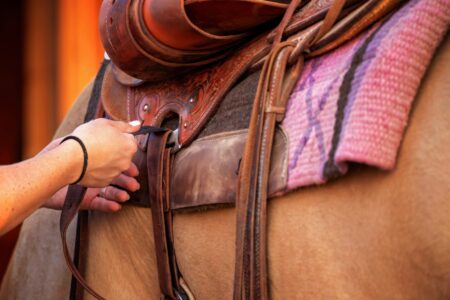
On a polo saddle, the flap D-ring sits flush against a panel of leather that absorbs lateral force from the rider’s knee and thigh. The ring itself is welded or cast rather than stamped, which gives it a density that stamped bag hardware rarely matches. That visible thickness – the way the metal catches light with a rounded, continuous curve rather than a flat pressed edge – is precisely what bag designers are replicating. When the same ring profile appears on a gusset seam, it signals construction quality through proportion rather than brand insignia.
The attachment geometry matters too. Saddle flap rings are typically riveted through multiple layers of leather, not sewn through a single layer of fabric. Bag hardware adapted from this tradition tends to use similar through-bolt or double-rivet mounting, which means the gusset panel itself becomes structurally reinforced wherever the ring sits. The hardware is not decorating the bag – it is participating in how the bag holds its shape under load.
That functional reasoning is what separates this trend from purely aesthetic hardware borrowing. A lot of equestrian-inspired accessories use stirrup shapes or snaffle-bit closures as surface decoration with no structural logic behind them. The gusset D-ring does not work that way. It exists on the bag because the gusset is the point of greatest expansion stress, and the ring provides a genuine attachment solution for compression straps, clip-on accessories, or secondary strap systems.

Why the Gusset, Specifically
The gusset has traditionally been treated as the invisible workhorse of bag construction – the panel that lets a tote expand from flat to full without losing its silhouette. Most hardware sits on the main body panels or the shoulder strap anchor points, places where it is easy to see and easy to reinforce. Putting hardware on the gusset means engineering a panel that is already under tensile stress to also carry the load of a mounted ring. That extra engineering step is part of why the look remained absent from mainstream bag design for so long.
A growing number of brands working in the structured accessories space are now treating that complexity as a selling point rather than a complication to avoid. A bag where the gusset carries visible, heavy-gauge D-rings reads as purpose-built – something closer to technical luggage or professional equipment than to fashion accessory. The equestrian sourcing of the hardware reinforces that reading without requiring any branding or explanation.
How the Hardware Changes the Silhouette
Place a D-ring on the flat face of a bag and it reads as decorative. Place it at the gusset seam – the line where the side panel meets the main body – and it immediately reads as structural. The ring bisects the bag’s profile when viewed from the front, drawing the eye to the depth and volume of the silhouette rather than to any surface graphic or logo. This is a meaningful shift in how a bag presents itself, especially in a market where clean, logo-reduced design is a priority for a wide range of consumers.
The polo saddle flap origin also contributes a specific visual weight. Equestrian hardware tends toward the heavier end of the gauge spectrum because it has to perform under physical stress, and that weight translates visually into permanence. A lightweight stamped ring on a gusset seam looks like a detail. A welded D-ring with the diameter and wall thickness of actual saddle hardware looks like architecture. The bag appears built rather than assembled.
Styling implications follow from that reading. Bags with gusset-mounted D-rings tend to resist being dressed down – they carry the visual authority of the hardware even when the rest of the bag is minimal. They also open up layering possibilities: clipping a second smaller pouch to the gusset ring, running a compression strap through it to collapse the bag for travel, or attaching a water bottle sleeve all become natural extensions of the hardware’s presence rather than workarounds.

This is also where the tension between equestrian specificity and broad fashion adoption gets interesting. Polo club hardware arrived at its current form through decades of functional refinement in a very particular context – grass fields, riders in motion, leather treated with neatsfoot oil. Translating that hardware to a urban bag gusset preserves the geometry but strips almost all of the original context. What remains is a silhouette and a material weight that now have to carry meaning entirely on their own terms. Whether that meaning holds across a broader market – or stays confined to the structured accessories buyers who already understand construction as a design language – is the question the gusset D-ring has not yet answered.
Frequently Asked Questions
What is a saddle flap D-ring?
A saddle flap D-ring is a welded or cast metal ring mounted on the leather panel of a polo saddle to anchor straps under lateral riding pressure. It is heavier and more structurally dense than typical stamped bag hardware.
Why are bag designers putting D-rings on gussets specifically?
The gusset is the point of greatest expansion stress on a bag, making it a logical anchor for rings that support compression straps, clip-on accessories, or secondary strap systems. The hardware reinforces the panel structurally while also changing the bag’s visual profile.