


When Equestrian Hardware Meets Fine Jewelry
The snaffle bit has long been one of the most recognizable pieces of equestrian hardware – a jointed mouthpiece connected by rings, designed for precise communication between rider and horse. Now that same geometry, specifically the lozenge link at the center of a double-jointed snaffle, is showing up in a different context entirely: as the connective element in minimalist chain necklaces worn far from any polo field. The crossover is not loud or branded. It is happening quietly, in small batches from independent jewelers and in the accessory edits of fashion-forward buyers who may not own a single riding boot.
What makes this particular moment worth paying attention to is the specificity of the reference. Polo club aesthetic has filtered into fashion before – collar details, boot silhouettes, belt hardware. But the snaffle bit lozenge link is a niche piece of vocabulary even within equestrian circles, and its arrival in fine jewelry points to how deep the current appetite for functional, sport-coded detailing actually runs. This is not a polo shirt moment. This is something more architectural.
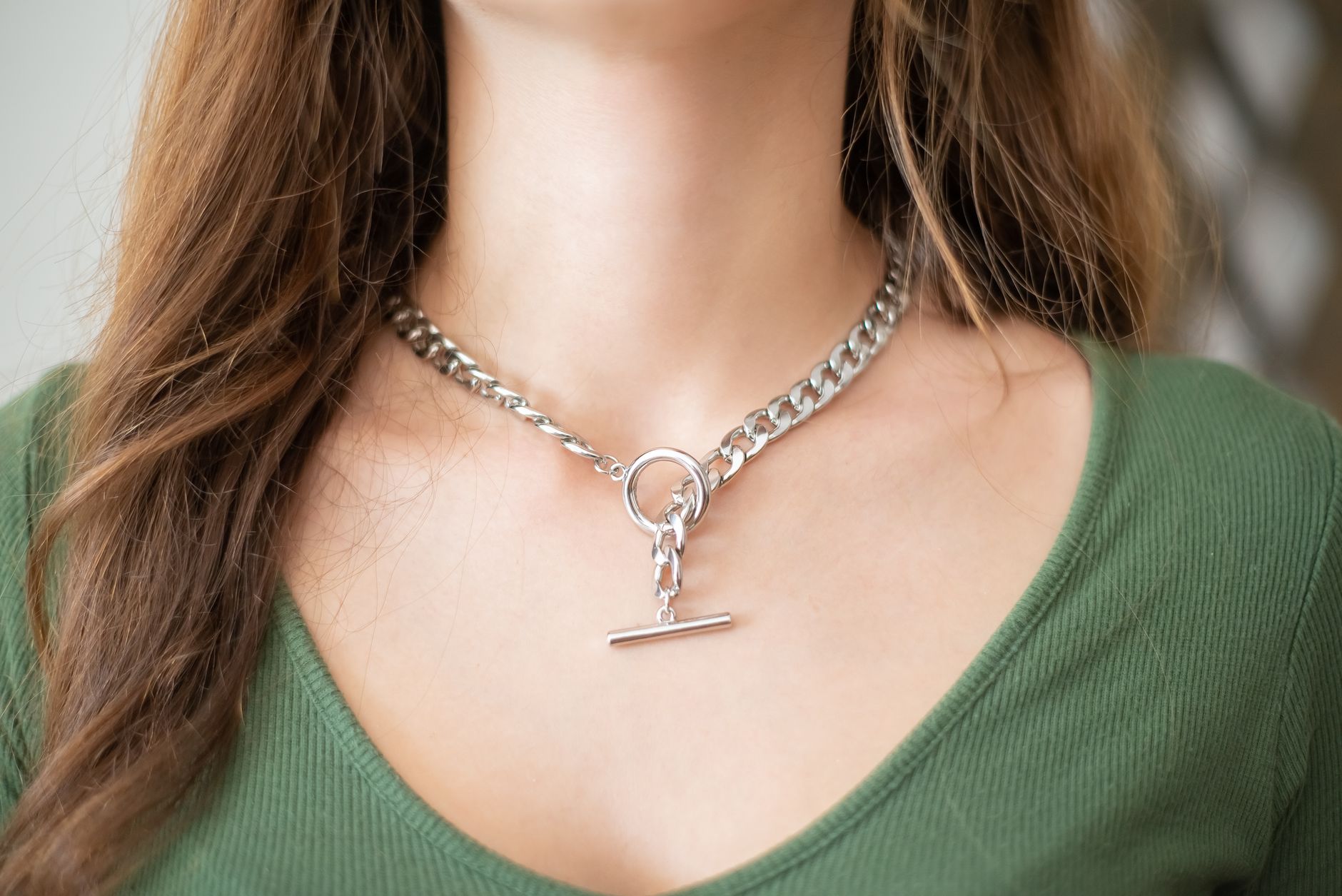
The Anatomy of the Link
To understand why the lozenge link works as jewelry, it helps to understand what it does on a bridle. A standard snaffle bit is jointed in the middle, which creates a nutcracker-like pressure when the reins are pulled. A double-jointed snaffle adds a second connecting piece – the lozenge – which distributes that pressure more evenly. The lozenge itself is an elongated, slightly curved oval, and when rendered in gold or sterling silver at a smaller scale, it reads less as a piece of tack and more as a considered design choice. The joint becomes a decorative pivot point. The geometry holds tension without looking heavy.
That functional logic is exactly what is attracting jewelry designers to the form. A chain built around lozenge-style connectors has inherent movement. Each link articulates independently because the original piece was engineered to flex. When scaled down to necklace weight, the result is a chain that drapes differently from a traditional cable or figaro – more fluid in some moments, more structured in others, depending on how it sits against the collarbone. The material origin gives the design a mechanical credibility that purely decorative chain styles rarely carry.
A growing number of independent jewelry studios are working within this territory without necessarily naming the equestrian reference directly. The pieces simply exist as chain necklaces with an unusual central link, or as pendant necklaces where the bail uses a lozenge connector instead of a standard jump ring. The polo world provides the blueprint; the jewelry absorbs it without the branding.
Why Minimalist Chains Are the Right Host
Minimalist chain jewelry has been the dominant fine jewelry category for several years running, and it is not slowing down. The reason the snaffle lozenge link integrates so naturally into this space is proportion. Minimalist chains succeed when every element justifies its presence – there is no room for a detail that reads as decorative filler. The lozenge link, because it comes from a world where form follows function with no tolerance for excess, brings exactly the kind of purposeful geometry that minimalist design demands. It belongs there in a way that purely ornamental links do not.
There is also a layering dimension worth considering. The lozenge link works as a statement on a single delicate chain, but it also anchors a layered neck stack where more uniform chains surround it. Because the link is slightly more dimensional than a flat cable link, it catches light differently and creates a natural focal point without requiring a traditional pendant. Stylists working with clients who want texture in their jewelry without committing to a maximalist direction are finding this useful.

The Polo Club Coding and Who Is Wearing It
Polo club aesthetic carries specific class and leisure associations – Sunday matches, tailored separates, a certain studied ease that implies access without announcing it. The snaffle bit has been part of luxury fashion coding for decades, most visibly through heritage brands that built entire accessory lines around equestrian hardware. But those iterations were always explicit: the bit was recognizable, branded, and worn as a status signal. What is happening now is different in register. The lozenge link necklace does not announce its equestrian origin. It requires the wearer to know, or to simply appreciate the object without the context.
That shift in how the reference operates matters to how the trend is being received. Fashion that codes its references subtly tends to age better than fashion that displays them loudly. A necklace built around a lozenge connector does not date itself to a specific branded moment – it sits in a longer timeline of jewelry that borrows from functional hardware without becoming a costume. The woman wearing it at a gallery opening in one city and the woman wearing it at a polo match in another are reading the same object through entirely different lenses, and both readings are valid.
The demographic appetite for this kind of piece is also worth observing. Younger buyers who grew up adjacent to equestrian sport – not necessarily as participants, but through the visual world of show jumping coverage, editorial fashion, and the broader cultural cachet of the polo circuit – have a literacy with this hardware that previous generations did not necessarily carry. They recognize the reference without having been formally taught it, and they are drawn to jewelry that speaks that language quietly.
Brands operating in the mid-luxury jewelry space are watching this. The challenge for larger labels is that the appeal of the lozenge link necklace right now is partly its restraint – the fact that it is not everywhere, not mass-produced, not the obvious choice. Independent makers can hold that position more easily than a label with wholesale accounts and production minimums. The moment a version appears in a major retailer’s fine jewelry case at scale, the conversation around it will shift. Whether the design survives that transition without losing what makes it interesting is the genuinely open question here.

For now, the most considered versions are appearing in small production runs – yellow gold lozenge connectors on trace chains, oxidized silver interpretations that lean more industrial than equestrian, and occasional mixed-metal pieces where the lozenge itself is a different finish from the surrounding links. The detail is doing a lot of work for a piece of hardware most people would not recognize outside of a stable.