


The Snap Hook’s Quiet Ascent
Polo club throat latch snap hooks – the small, spring-loaded clasps originally designed to secure a horse’s bridle at the throatlatch – have found an unlikely second life on the lapels, collars, and front plackets of minimalist jackets. What was once purely utilitarian equestrian hardware is now appearing on structured blazers, field-style coats, and tailored bombers, replacing the conventional button or hidden magnetic closure with something that feels both mechanical and precise.
The appeal is not nostalgia for the stables. It’s the hardware’s geometry. A snap hook closes with a satisfying click, holds flush against a garment’s face, and carries a visual weight that reads as intentional rather than decorative. Where a button whispers, a snap hook makes a considered statement – one that sits comfortably inside the minimalist design vocabulary without tipping into ornamentation.
What Makes Equestrian Hardware Work on Structured Jackets
The throat latch snap hook’s dimensions are what make the crossover work. Originally sized to hold leather bridle straps under tension, the hook typically runs between 35mm and 55mm in length with a spring-loaded gate that opens under thumb pressure and locks closed under load. On a jacket, that same mechanism translates to a closure that holds a lapel flat, keeps a collar band secured without bulk, and releases quickly with one hand – a functional logic that actually improves on the button in certain contexts.
The material palette helps too. Equestrian snap hooks are manufactured in solid brass, stainless steel, and nickel-plated zinc, all of which carry the kind of tonal consistency that minimalist design depends on. Paired with wool crepe, technical canvas, or structured cotton twill, the hardware doesn’t fight the fabric – it anchors it. The gate mechanism, when closed, becomes essentially flush with the hook body, which means the silhouette of the garment reads as clean rather than interrupted.

How Designers Are Integrating the Closure
The most common placement puts a single snap hook at the collar band, functioning where a top button or hook-and-eye would traditionally sit. This is the subtlest application – the hook closes the collar when worn up, releases when the collar is folded down, and stays mostly hidden in both positions. It’s a detail most people wouldn’t name unless they handled the garment directly.
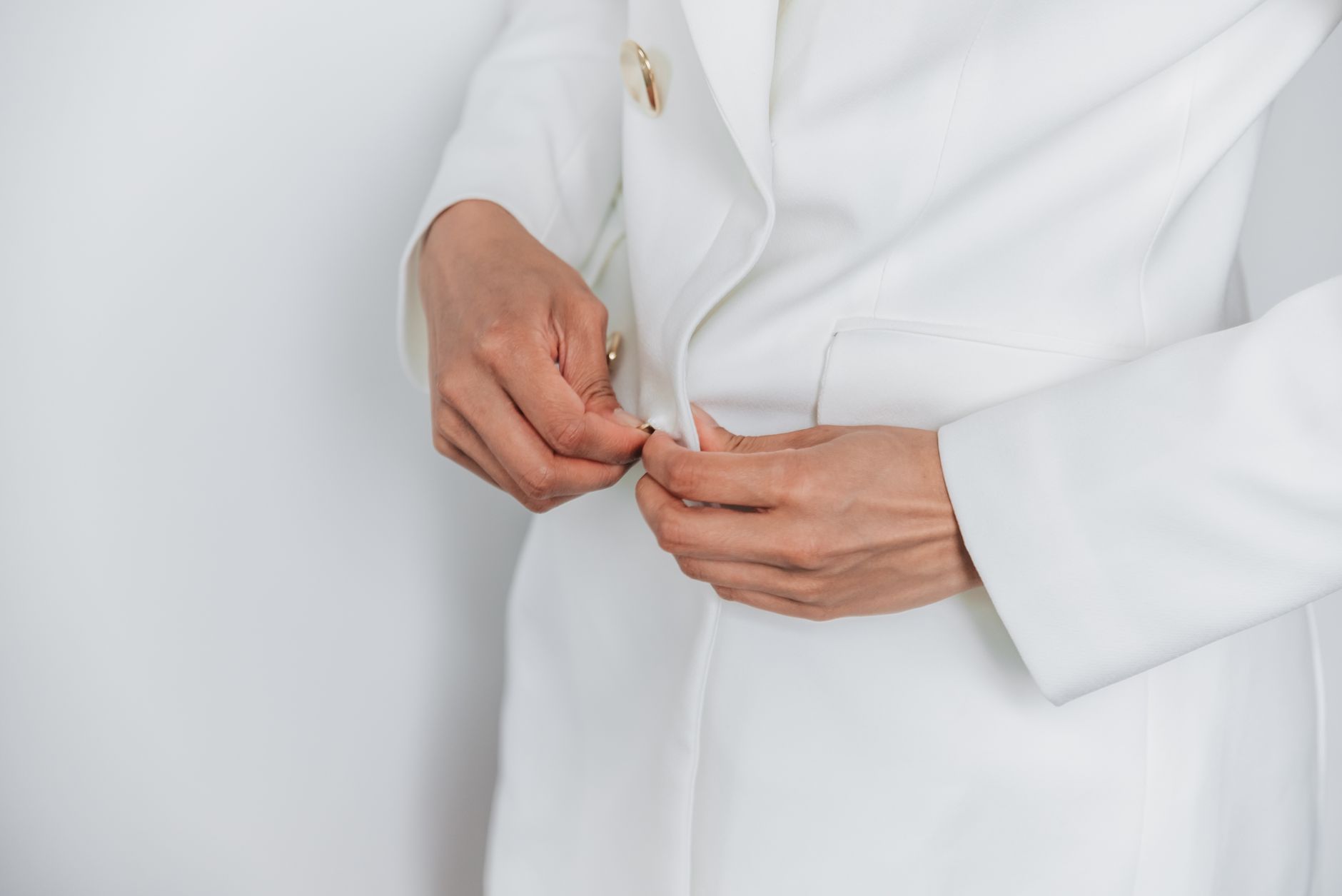
A more visible approach runs two or three snap hooks down a jacket’s front placket as the primary closure, replacing buttons entirely. This requires a corresponding fixed ring or dee ring on the opposite panel – hardware that the equestrian world also supplies in abundance, where dee ring loops have been doing exactly this kind of anchoring work on belt hardware for some time. The result is a jacket front that looks deliberately industrial rather than casually fastened.
Some designers are using snap hooks at the cuff, closing sleeve vents the way a horse’s leg bandage is secured – with a single fast-release hook rather than a button. It’s a small substitution with a strong payoff: the cuff closes cleanly, the hardware adds visual punctuation at the wrist, and the whole sleeve reads as architectural. A single one-sentence note is worth making here – the spring gate, when it catches light, functions as an accent without being added for that purpose.
There is also a version of this trend appearing in outerwear, specifically on field coats and barn-style jackets where the equestrian reference is more overt. Here, snap hooks close the storm flap over a zip, secure a belt tab at the back, or hold a detachable collar in place. The design logic in these cases is essentially borrowed wholesale from the tack room – and it shows, in the best possible way.
The Minimalist Logic Behind Functional Hardware
Minimalist fashion has always had a complicated relationship with hardware. The temptation is to eliminate it entirely – to reduce a garment to fabric and form with no visible fastening at all. But that approach can read as sterile, particularly on structured jackets where the eye needs a fixed point. A snap hook provides that point without adding decoration, because it is not decorative. It is there because it works, and the visual interest it generates is a side effect of that function rather than its purpose.
This is precisely why equestrian hardware keeps cycling back into minimalist wardrobes. Polo club equipment is engineered for performance under physical stress, designed to be operated while wearing gloves in poor weather, and built to last years of hard use. None of that engineering is about how the hardware looks. The aesthetic arrives as a consequence of the engineering, which is a different logic from fashion hardware – and that difference is legible on a garment.
Where the Trend Is Landing
The snap hook closure is appearing most frequently in the quieter corners of the market – small-run tailoring labels, workwear-influenced design studios, and the kind of brands that treat hardware sourcing the way a chef treats ingredient sourcing. The hooks themselves are often purchased directly from equestrian supply companies, which means the same snap hook closing a jacket lapel in a boutique might also be securing a bridle in a competition barn somewhere.
The price point of the hardware is genuinely low relative to its visual impact. A solid brass throat latch snap hook costs a fraction of a custom-cast button, holds more securely, and requires no buttonhole – eliminating a construction step that has always been a quality vulnerability in tailored garments. For small-batch producers, that equation is worth paying attention to.
What remains unresolved is how the snap hook closure performs across different body types and wearing habits. The fixed ring position on the opposite panel must be set with precision or the closure pulls the jacket front off-center – a fitting problem that buttons avoid simply by offering multiple hole positions along a placket. When the placement is right, the closure is nearly perfect. When it’s off by a centimeter, the whole front of the jacket announces that fact every time it’s worn.