

The Boater’s Quiet Return
The Eton boater – that rigid, flat-brimmed straw hat worn by English schoolboys and punted along the Thames for well over a century – was never supposed to be fashionable again. It was institutional, ceremonial, practically a prop from a period drama. Yet something has shifted in the way designers are reaching into British heritage for structural silhouettes, and the boater’s flat brim has become the unexpected focal point of summer millinery conversations happening in ateliers from London to Milan.
What’s drawing designers back isn’t nostalgia. It’s architecture.
The boater’s defining feature – that perfectly horizontal, wide, stiff brim with a clean-cut edge – offers something that floppy sun hats and baseball caps simply don’t: a geometric frame for the face and shoulders that functions almost like accessory sculpture. Where most summer hats soften and drape, the boater commands. That structural logic is exactly why it’s being revisited now, at a moment when structured tailoring and sharp silhouettes are pushing back hard against years of fluid, relaxed dressing.

From Regatta to Runway
The original Eton boater earned its rigidity from blocked sennit straw – a tightly braided, lacquered weave that kept its form regardless of summer heat. Modern millinery designers working in this space are largely preserving that material commitment, understanding that the hat’s authority comes directly from its refusal to yield. Softened interpretations exist, but the versions gaining real traction are the ones that maintain the flat crown and knife-edge brim with almost obsessive precision.
Colour is where the contemporary angle opens up. The classic boater arrived in natural straw or black, often dressed with a grosgrain ribbon in school or rowing club colours – a tradition still very much alive in pieces like rowing club stripe knitwear crossing into resort fashion. Right now, milliners are experimenting with the ribbon band as a design statement in its own right: wide satin bands in deep burgundy, narrow grosgrain in cream and black stripe, or completely ribbon-free brims that let the raw straw edge speak for itself. A growing number of smaller hat labels are also introducing the form in bleached white raffia and painted black lacquer finishes that push the silhouette further toward avant-garde territory without sacrificing its essential geometry.
Styling in editorial and street contexts is landing in two distinct directions. The first keeps the boater in its heritage lane – worn straight and level with a striped linen blazer, high-waisted trousers, and leather loafers, leaning fully into the Edwardian picnic aesthetic. The second tilts the brim deliberately, perching the hat at an angle that reads more contemporary and slightly subversive. That tilt, small as it sounds, changes the entire register of the look. It softens the institutional rigidity just enough to make the hat feel personal rather than costumed.
The Brim as the Whole Point
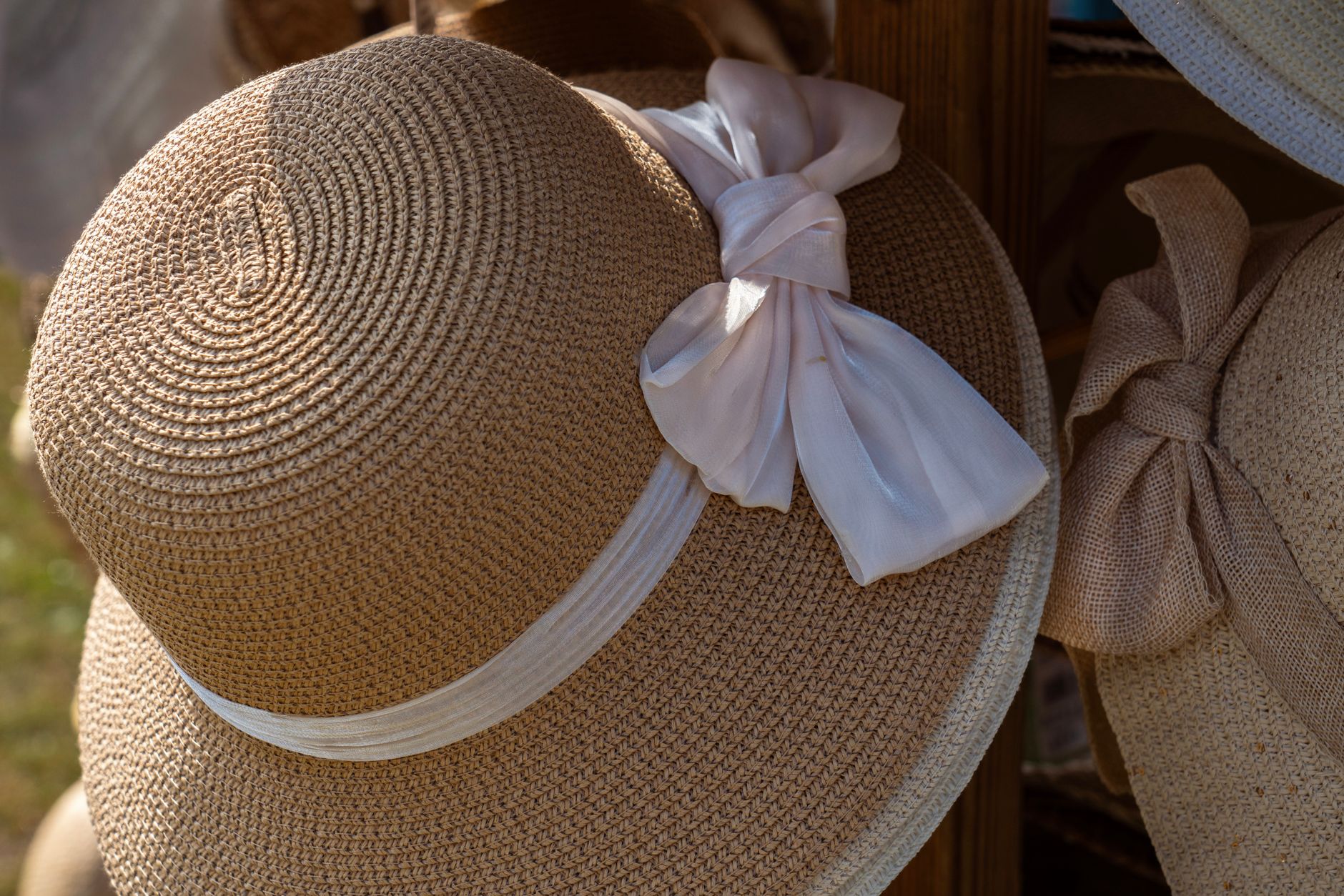
Millinery tends to cycle through hat shapes in waves – the wide-brim floppy hat dominated summer accessory coverage for years, and before that the fedora ran its long course through both men’s and women’s wardrobes. The boater sits at an interesting crossroads because it borrows elements from both without fully belonging to either. Its brim is wide enough to read as a sun hat but structured enough to carry the weight of a formal accessory. That ambiguity is, commercially and creatively, the thing making it interesting to a new generation of hat wearers who don’t want to commit to a single aesthetic lane.
There’s also a gender conversation happening around the form. The Eton boater was historically coded as male – school uniform, rowing club, Henley Regatta – but contemporary styling has stripped that context almost entirely. Women wearing oversized boaters with bias-cut midi dresses or bare-shoulder tops has become a recurring image across summer lookbooks, while men are finding the hat pairs with relaxed tailoring in ways that feel modern rather than theatrical. The hat is being reclaimed as a shape first, a symbol second.
Price points are creating a clear market split. Handmade blocked straw boaters from established London milliners carry price tags that reflect weeks of skilled craft work – these are investment pieces built to last decades if stored correctly. Meanwhile, a wave of more accessible versions in machine-pressed raffia and synthetic straw is making the silhouette available at a much lower entry point, though the brim rigidity on cheaper versions often fails to hold through a full season of wear. The difference is immediately visible: a properly blocked boater sits level with clean shadow lines under the brim, while an inferior version begins to curl and soften within weeks.

A Shape That Refuses to Apologize
What the boater’s quiet resurgence actually demonstrates is that the most compelling accessory revivals aren’t driven by irony or costume play – they happen when a functional, well-engineered form finds new relevance through contemporary styling without being asked to change its essential nature. The boater brim is exactly as flat, exactly as rigid, and exactly as unapologetic as it was in 1900. The only thing that’s changed is who’s wearing it, and why.