

Equestrian hardware has long been engineered for function over form – but the polo club crupper back strap, a piece of tack designed to keep a horse’s tail dock in place, is now doing something entirely unexpected. It’s showing up on backless evening wear as a decorative and structural element, threading across bare skin with the same tension and precision it was built to deliver.

The Tack Room Influence Nobody Predicted
The crupper back strap works on a simple mechanical principle: a loop, a strap, and a point of anchor that distributes tension across a curved surface. Applied to backless dress construction, that same logic translates with surprising elegance. Designers working in eveningwear and resort collections have been experimenting with strap configurations that echo the Y-shaped and D-ring arrangements typical of crupper hardware, positioning them along the lower back where a traditional closure would otherwise be invisible.
What makes the crossover feel less like a costume choice and more like a genuine design development is the restraint being applied. The straps appearing on current silhouettes are not theatrical or exaggerated. They sit close to the body, finished in tanned leather, burnished brass, or matte black hardware that reads as jewelry rather than tack. A gown with a plunging open back becomes architecturally interesting when a single strap bridges the gap at the sacrum, anchored by rings that mirror the D-ring fittings on a working crupper.
Equestrian aesthetics have cycled through fashion for decades, but most of those cycles have stayed north of the waist – bits repurposed as belt buckles, stirrup shapes in heel design, browband crystals reworked into hair accessories. The crupper back strap is different because it’s being adopted not just as a visual reference but as an actual structural solution. It holds fabric. It creates tension. It earns its place on a garment by doing what it was designed to do.
The timing tracks with a broader appetite for visible construction in fashion. When the interior logic of a garment – the boning, the binding, the hardware – becomes part of the aesthetic rather than something to conceal, equestrian tack becomes a very credible source material. Polo equipment in particular is designed to withstand sweat, movement, and pressure, which means its hardware is both robust in form and refined enough to be displayed without embarrassment.
How the Hardware Is Being Translated
The most direct translation lifts the crupper’s signature shape almost whole – a rear loop that sits at the base of the spine, connected to two straps that angle upward and outward before anchoring to the sides or shoulders of a garment. On a horse, those straps run beneath the tail. On a backless dress, they run across exposed skin, creating a strapping effect that has a visual intensity far out of proportion to how little material is actually involved. A single three-quarter-inch strap crossing a bare back at the right angle changes the entire weight of a silhouette.
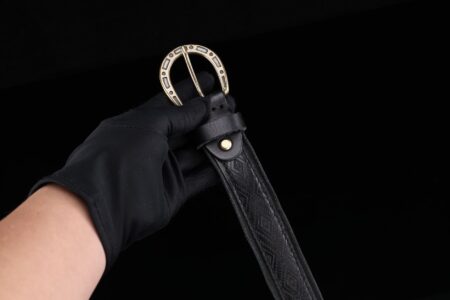
Hardware choices are where designers are making their most deliberate decisions. Solid brass D-rings and roller buckles – the kind used in high-quality English tack – have a weight and finish that reads as luxury without performing as costume. Some pieces are working with nickel-plated fittings for a cooler, more industrial result, while others are choosing antique bronze to stay within the warm, burnished register that polo equipment has always occupied. The ring itself, when used as an exposed back closure, becomes a focal point the way a brooch or a jeweled clasp would on a more traditional garment.
The leather element is more complicated. Working with leather against bare skin on a garment that needs to be worn, washed, and stored like clothing requires a different material approach than saddlery. Some designers are solving this by using vegetable-tanned leather cut thin enough to move with the body without stiffness, while others are replacing leather entirely with structured grosgrain or a double-faced silk that mimics the strap profile without the maintenance problem. The result looks like tack, behaves like fashion, and requires neither a saddle nor a stable.
Cut placement follows the crupper’s logic more than any particular fashion convention. Because the crupper sits specifically at the rear of the horse and anchors upward, its translated position on a dress falls at the small of the back or just below, which happens to be the exact zone that backless eveningwear most needs structural help. A deeply open back loses its drama when the fabric pulls or shifts during wear. The strap system borrowed from crupper design addresses that problem while turning the hardware into the reason to look at the back of the dress at all.
Sizing and adjustability are, arguably, where the tack influence is most practical. A crupper back strap is by design adjustable – it has to accommodate different horses and different fits. That same adjustability, built into a dress via roller buckle or tongue-and-bar closure, means a single backless silhouette can work across a wider range of body types without alteration. The fit mechanism isn’t hidden inside a seam. It’s visible, intentional, and functional, which is the entire point.
Where This Is Landing on the Market
The strap-back silhouette with visible hardware is appearing most consistently in resort and evening categories, where backless construction already has the most established real estate. Smaller independent labels working in structured eveningwear have been quickest to adopt the look, partly because the hardware sourcing is straightforward – equestrian supply companies carry exactly the fittings required – and partly because the aesthetic aligns with a customer who wants her formal wear to feel considered rather than conventional.

Styling the look requires very little additional effort, which may be part of why it’s gaining traction. The hardware at the back functions as jewelry, which means the front of the garment can stay completely undecorated without feeling unfinished. It also means there is nothing to remove, store, or lose before the dress goes on. The strap is the statement. Whether that statement will hold at the level of major formal occasions – red carpet, black tie, evenings that require a hotel press – is a question the hardware will have to answer the hard way.