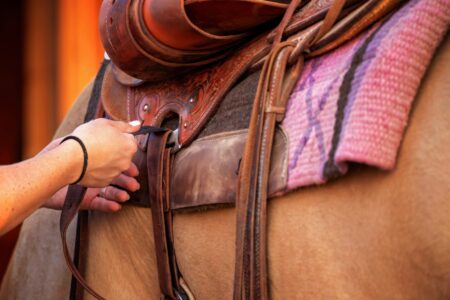


When Equestrian Detail Meets Tailoring Precision
Saddle flap skirts on polo club gear have always carried a certain structural authority – the way the flap sits flat against the leg, edged with a clean line of piping that exists for grip and durability, not decoration. That same logic is now migrating into womenswear and tailored trouser construction, where piping once reserved for sportswear is appearing along inseams, fly panels, and rear seams with a quiet, deliberate confidence.
The crossover is not random. Equestrian-inspired fashion has long provided tailoring with some of its most enduring codes – the riding boot silhouette, the hacking jacket, the jodhpur cut. Piping is simply the latest transfer. What makes this moment different is that the borrowing is happening at the seam level, inside the architecture of the garment, rather than as surface decoration tacked onto a silhouette.

The Anatomy of Saddle Flap Piping
On a polo saddle flap, piping runs along the outer edge to reinforce the leather against friction and wear. It is typically a narrow welt of folded material, stitched tight and flush, creating a raised ridge that signals durability before it signals style. The construction is functional first – the aesthetic is a byproduct of the engineering. Saddle makers have used this technique for centuries because it holds shape under pressure and distributes tension across the seam rather than concentrating it at a single stress point.
Trouser construction borrows this logic directly. When a tailor runs a narrow pipe along the outseam of a wool trouser – the stripe on a tuxedo leg being the most familiar example – the same principle applies. The pipe reinforces the seam, adds a slight stiffness that keeps the leg line clean when walking, and draws the eye along the vertical in a way that plain stitching cannot. The military stripe, the braid on a hussars uniform, the satin outseam on a dinner suit: all of them trace back to functional piping that became a status marker over time.
What is happening now is a refinement of that lineage. Rather than the wide satin stripe or the obvious braid, designers are working with extremely narrow piping – sometimes under 3mm wide – placed at inseams, crotch seams, and pocket mouths. The result reads as tailoring precision rather than decoration. You notice it only when the light catches it, or when you see the trouser from behind.

Why Structured Seams Are Gaining Ground
Tailored trousers have had a difficult decade. The rise of stretch fabrications and relaxed silhouettes pushed structured construction to the margins of commercial fashion. What is pulling it back is not nostalgia – it is a practical frustration with garments that lose their shape after a few hours of wear. Piped seams hold the silhouette in a way that a plain seam in stretch fabric cannot, because the piping acts as a physical spine along the leg.
The saddle flap reference is doing something beyond functional reinforcement, though. It is importing a specific vocabulary – sport, precision, outdoor activity performed at high skill – into workwear and evening contexts where that vocabulary lands differently than it would have twenty years ago. Polo club detailing is working through multiple garment categories at once, and the trouser seam is simply the most understated point of entry.
How the Detail Is Being Executed
The most effective versions currently appearing in tailoring are using self-fabric piping – the same cloth as the trouser body, cut on the bias and folded into a welt before being stitched into the seam allowance. This creates a raised line that reads as architectural rather than decorative. Because the fabric matches, the eye registers the shadow and texture of the welt before it registers color contrast. The effect is structural complexity without visual noise.
Contrast piping is appearing too, but with restraint. Cream piping on navy wool, white on charcoal, narrow tan on brown cavalry twill – the combinations being used right now are deliberately muted. The goal is the suggestion of equestrian precision rather than a literal costume reference. A trouser with cream piping at the inseam reads as sharply tailored from a distance; only up close does the specific reference become legible.
The placement decisions are where craft becomes most visible. Piping at the outseam is the classic application and the most forgiving to execute. Inseam piping is harder – the seam curves through the crotch and down the inner leg, requiring the pipe to ease around a complex geometry without puckering. Pocket mouth piping is the most demanding of all, because the pipe has to survive the stress of a hand being inserted repeatedly without breaking down at the corners. Saddle makers understand this problem well; they pipe the edges of flaps precisely because those edges take the most contact and flex. Trouser makers are relearning the same lesson.
The result, when the execution is correct, is a trouser that holds its pressed crease longer, resists the bagging at the knee that plagues unstructured tailoring, and ages in a way that improves the garment rather than degrades it. That is the specific promise piping has always made in equestrian gear – a saddle flap piped correctly will outlast the stitching on an unpiped one by years. Whether the same longevity translates to fashion cycles rather than riding seasons is the tension that makes this trend genuinely interesting to watch.

Frequently Asked Questions
What is saddle flap piping and why does it matter for fashion?
Saddle flap piping is a reinforced welt of folded material stitched along the edge of equestrian gear for durability. In fashion, it translates into structured trouser seams that hold shape and add architectural detail.
How is piping applied to tailored trousers?
Piping is stitched into the seam allowance along outseams, inseams, or pocket mouths using either self-fabric or subtle contrast material, creating a raised ridge that reinforces the seam and sharpens the silhouette.