

There is something happening at the intersection of equestrian function and street-ready dressing that most trend forecasters haven’t clocked yet. The grooming apron – long a fixture of polo stable yards, worn by grooms managing horses between chukkers – is showing up in unexpected places. Independent designers and workwear-adjacent labels are pulling its silhouette out of the barn and placing it squarely in conversations about protective outerwear with actual aesthetic weight.
The garment itself has always had the bones for this crossover. A polo pony grooming apron is typically constructed from heavy canvas, waxed cotton, or water-resistant nylon, cut long enough to protect the legs from horse sweat and hoof-cleaning runoff. It ties or buckles at the back, sits close to the body, and features deep utility pockets at the thigh. That combination – structured front panel, flexible closure, working-class durability – reads very differently when it’s removed from the stable context and placed on a city sidewalk.

Where the Silhouette Comes From
Polo stable culture has its own strict dress code, and the grooming apron sits at the bottom of that hierarchy in the best possible way. It is purely functional gear, never meant to impress anyone. Grooms wear them during the fast-moving intervals between periods of play, when horses need to be wiped down, re-tacked, and assessed for injury. The apron absorbs the mess so the groom’s underlying clothing doesn’t. There is no decoration, no branding, no performance of status.
That absence of pretense is exactly what makes it interesting now. Fashion has spent the better part of a decade mining workwear traditions for credibility – denim coveralls, carpenter pants, boilersuit silhouettes. The grooming apron is simply the next logical source material in that lineage. It arrives with a more specific and less commercially exhausted history than, say, the mechanics’ jumpsuit, which means designers have more room to define what it means outside its original context.
The construction logic also holds up under scrutiny. The front-panel-only design means the garment is genuinely easy to layer over existing clothes, in a way that a full apron or a smock is not. You can wear it over a coat. You can wear it over a suit. It doesn’t compress or wrinkle whatever sits underneath, because it only covers what it needs to cover. That structural advantage is something a lot of fashion-forward outerwear pieces sacrifice in favor of a cleaner overall line.
The Utilitarian Outerwear Angle
Utilitarian outerwear as a category has been expanding steadily, with brands across price points experimenting with garments that can justify their bulk through actual function. The grooming apron fits neatly into that logic. Its material palette – waxed cotton especially – already has crossover credentials through the fishing and hunting gear market, where the same fabrications have been repositioned as premium casual outerwear for years. The leap from waxed hunting vest to waxed grooming apron is not as large as it first appears.
What separates the grooming apron from similar utilitarian adaptations is the pocket placement. Thigh-level pockets read as workwear in a direct, unambiguous way. They aren’t decorative. They sit where a working person actually needs them, not where a stylist would position them for a cleaner silhouette. That specificity of detail tends to be the thing that separates a genuine workwear derivation from a fashion costume version of one.

How Designers Are Translating the Form
The translation from stable gear to wearable outerwear requires more editing than it might seem. The raw proportions of a grooming apron are calibrated for someone who is crouching, lifting, and moving around a 1,200-pound animal. The hem sits well below the knee to keep the legs covered, and the bib section is cut wider than typical fashion apron silhouettes to allow full arm movement without the garment riding up. When designers work with this shape, they generally have to decide how much of that extreme functionality to preserve and how much to trim back for a cleaner street silhouette.
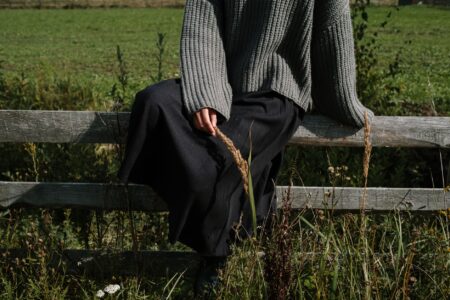
The most interesting versions being produced right now are the ones that preserve the length. A mid-calf grooming apron worn over wide trousers or a long skirt creates a layering combination that doesn’t have a direct reference in mainstream outerwear. It reads as protective in a way that feels contemporary – more armor than decoration – and the long front panel creates a strong vertical line that works particularly well against oversized knitwear or structured shirting. The silhouette rewards deliberate dressing rather than casual throwing-together, which positions it slightly apart from the easy-wear utilitarian pieces that have dominated the market.
Material choice is where the category gets genuinely varied. Waxed cotton brings the strongest equestrian-to-outdoors reading, but some smaller labels are exploring heavy linen for a warmer-weather version that retains the structured front panel without the waterproofing weight. Industrial canvas versions, sometimes stonewashed or enzyme-treated to soften the hand, sit closest to the construction workwear aesthetic that sportswear-derived garments have been occupying in avant-garde streetwear. Each material choice pulls the apron’s identity in a slightly different direction, which means the category doesn’t yet have a fixed visual signature.
Colorway is the one area where the equestrian origin story tends to disappear entirely. Traditional grooming aprons are navy, brown, or dark green – practical choices that hide staining. Contemporary adaptations are moving into undyed natural canvas, slate grey, and even off-white, which signals a deliberate inversion: the apron-as-outerwear isn’t trying to hide evidence of work, it’s presenting itself as something that was never meant to get dirty in the first place. That shift in implied use is what ultimately distinguishes the fashion object from the functional one, and it raises the question of whether the grooming apron can carry its character once that original gritty purpose has been fully laundered out.