


There is a quiet crossover happening between the world of lawn sport equipment and fine jewelry design, and it is not accidental. The lacquer rings that band croquet mallet shafts – those tight, painted or resin-coated hoops that reinforce the wood near the handle – have caught the eye of jewelry designers looking for a new visual grammar for minimalist stacking rings.

Where the Reference Comes From
Croquet mallets are built with functional banding: rings of lacquer, sometimes in a single color, sometimes in a deliberate sequence of two or three, wrapped tightly around the shaft to prevent splitting and to mark grip placement. They are precise, repetitive, and deeply undecorated. The rings do not attempt to be beautiful. They just are – and that restraint is exactly what has made them worth borrowing.
Jewelry designers working in the minimalist space have spent the better part of a decade navigating the tension between “barely there” and “visually interesting.” A single thin band reads as elegant but risks disappearing entirely. Too many stacked bands with varied textures compete for attention and tip into noise. The croquet mallet reference solves this by suggesting a rule: bands spaced with intention, uniform in width, differentiated only by material or finish rather than by shape.
The specific detail that translates is the gap between rings. On a mallet shaft, the bands are not flush against each other – there is bare wood showing between each one. That negative space is load-bearing visually. It is what makes each ring feel deliberate rather than crowded. In a ring stack, that principle plays out as thin metal bands worn with precise knuckle-width spacing, each ring sitting independently rather than touching its neighbor.
Some designers working in this space describe their stacks in terms of “interval” – a word borrowed more from music than from fashion. The croquet mallet aesthetic supports that framing entirely. Each band is a note; the space between is the beat.
How the Trend Reads on the Hand
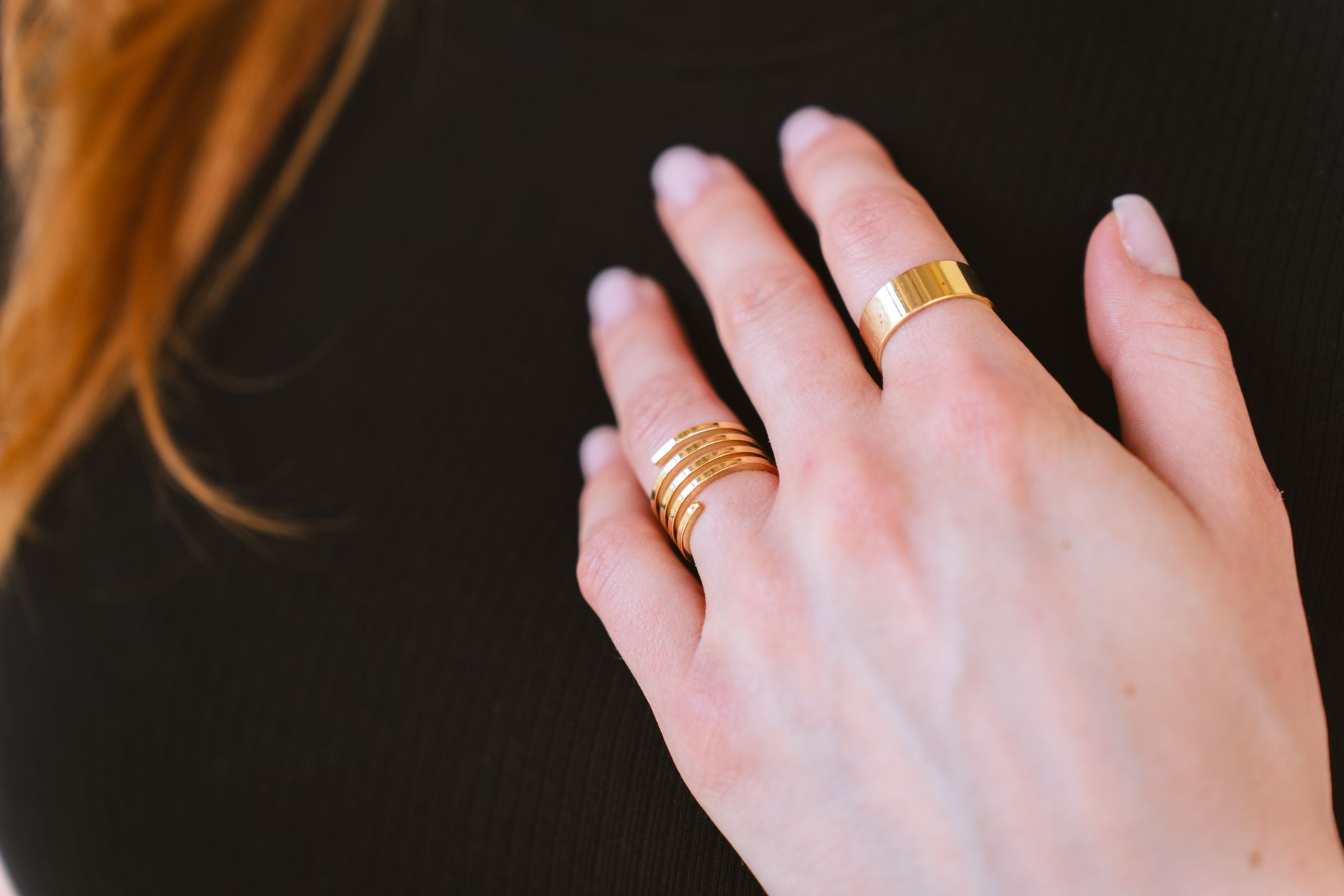
The visual signature of a croquet-shaft-inspired stack is easy to identify once you know what you are looking at: three to five rings of near-identical width, worn on one or two fingers, in materials that shift incrementally – from yellow gold to rose gold to white gold, or from brushed steel to high-polish silver. No gemstones. No twisted wire. No hammered texture fighting for dominance. The variation is tonal, not structural.
This is a meaningful departure from the maximalist stacking that dominated social media for much of the early 2020s, where mismatched vintage bands, signet rings, and chunky statement pieces were layered together in what stylists called “collected over time” arrangements. That aesthetic is not gone, but it has aged into something that reads as slightly effortful – too conscious of its own eclecticism. The croquet-shaft approach reads as the corrective: coherent, quiet, almost architectural.
The color sequencing element is where the trend gets genuinely interesting. On a traditional mallet, the lacquer rings might run navy, red, navy – a simple repeat with a center accent. Translated into metal, that same logic produces a stack where two yellow gold bands flank a single oxidized silver one. The center ring becomes the fulcrum without announcing itself as the “statement piece.” It is structure, not decoration.
Finger placement matters more in this approach than in looser stacking styles. A single ring wearing three uniform bands reads as armor. Splitting the sequence across the index and middle finger with a gap at the ring finger reads as rhythm. The mallet reference holds: those bands are always measured, never casual about where they land.
There is also a material logic here that suits the current appetite for investment dressing. Thin, unembellished bands in solid gold or sterling silver are among the most wearable, most durable jewelry forms available. They do not snag. They do not read as too formal or too casual. A well-chosen sequence of three bands in a single metal family becomes an almost permanent fixture – jewelry you stop taking off because removing it would feel like losing something architectural about your hand.
The Styling Calculus
The stack works best when the rest of the jewelry picture is equally restrained. One sport-reference-inspired ring sequence on the right hand, nothing on the left, no earrings competing for attention – that is the full outfit when the rings are the point. Stacked bands read richest against skin that is unencumbered by bangles or bracelets on the same arm, because the whole aesthetic depends on the geometry being visible rather than context-drowned.

What makes this particular reference durable as a design direction – beyond this season – is that it is rooted in function rather than trend cycling. Croquet mallet banding exists because it works mechanically. The visual language it produces is not invented for aesthetics; it evolved under constraints. That kind of foundation tends to produce jewelry that does not expire. The question worth sitting with is whether the fine jewelry market, which has a long history of borrowing from equestrian and polo aesthetics, is ready to extend that same cultural credibility to a sport that has always lived slightly outside mainstream luxury’s comfort zone.