

Fives football chest guards – those rigid, lightweight protective shells worn by players in small-sided cage football – are quietly crossing over from the pitch into fashion, showing up in padded vest drops from a growing number of streetwear labels. The silhouette is too good to ignore: angular, structured at the sternum, and inherently utilitarian in a way that current menswear keeps chasing.
From Cage Sport to Street Silhouette
The original chest guard exists purely for function. In fives football – played in hard-court cages with metal boards and zero margin for cushioned falls – protecting the sternum and ribs is practical, not performative. The guard typically sits over a base layer, held in place by velcro straps or compression sleeves, and covers roughly the same real estate as a fitted vest. That proportional overlap is exactly where fashion started paying attention.
What designers are extracting from the chest guard format is the chest plate geometry – a defined, slightly raised panel running from collarbone to lower sternum, often flanked by articulated side panels. Translated into a padded vest, that structure adds dimension without bulk. The front stays stiff and graphic while the back remains soft and wearable. It reads as armor-adjacent without committing to the full tactical silhouette that saturated menswear a few cycles ago.
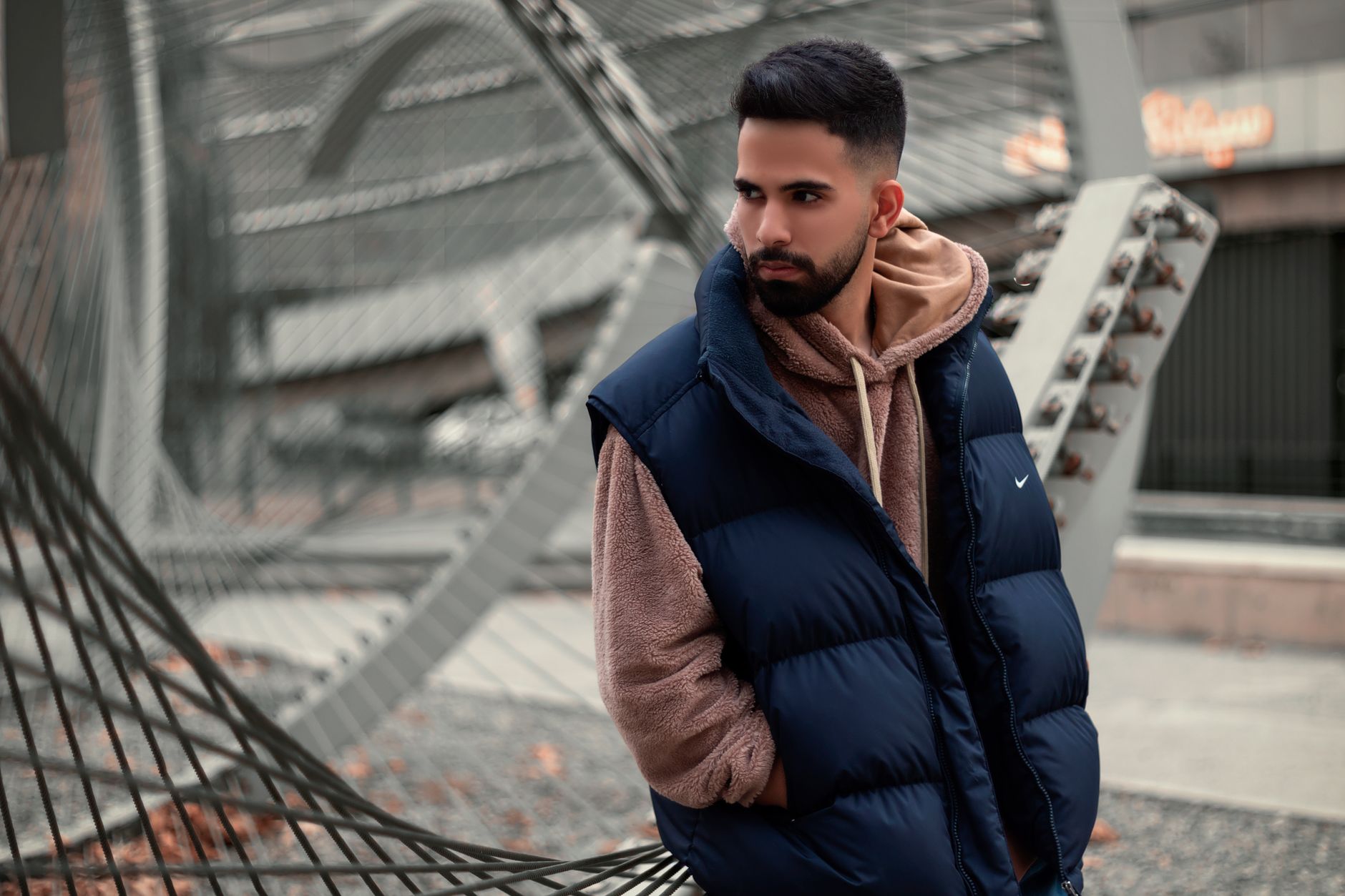
Several independent labels have begun dropping vests that borrow this exact construction: quilted or foam-paneled fronts with a hard-shell feel, jersey or ripstop backs, and low-profile side zips that mimic the access points on protective sportswear. The color palette tends to stay close to the source material – black, high-vis yellow, concrete grey – with occasional departures into earthy tones when the vest leans more lifestyle than sport.
The timing makes sense. Protective sportswear has been feeding into fashion at an accelerating rate, with cycling gear, motocross padding, and fencing plastrons all leaving traces in recent seasons. Fives football just happens to be next in line, partly because the sport itself has grown sharply in urban markets across the UK and Europe, and the aesthetic is now visible enough to carry cultural weight outside the cage.

How the Vest Drops Are Being Built
The construction approach varies by brand, but the most convincing versions treat the chest panel as the load-bearing design element rather than decoration. Some labels are working with EVA foam inserts – the same material used in actual chest guards – bonded between an outer shell fabric and an interior mesh layer. The result compresses slightly under pressure, which gives the vest a tactile quality that flat quilting cannot replicate. You feel the structure when you put it on, and that physicality is part of the appeal.
Strap detailing is the other major carry-over. Fives chest guards use adjustable velcro or buckle straps to secure the panel against the body, and several of the vest drops are incorporating visible strap hardware at the shoulder and side – not as functional closures, but as surface detail that signals the reference clearly. It is a similar logic to how motocross-inspired jackets kept the shoulder clasps even after the protective padding was removed.
Layering is built into the concept by default. Because the original chest guard is designed to sit over a base layer, the vest version carries that same assumption – it is not an outer layer that closes over everything underneath, but a mid-layer meant to be seen in combination with a heavyweight tee, an open shirt, or a technical long-sleeve. That layering dependency actually makes the piece more versatile in practice, since the visual effect changes significantly depending on what is worn beneath it.
Some drops are pushing further by treating the back panel differently from the front – keeping the chest construction rigid while making the back entirely soft, almost T-shirt weight. The asymmetry of that approach creates a garment that photographs interestingly and wears comfortably, which is a balance that full-padded outerwear rarely achieves. It also keeps the price point lower than a fully constructed technical vest, which matters when the target customer is buying into a trend rather than a long-term wardrobe staple.
The silhouette also connects naturally to the ongoing conversation around numbered and graphic sportswear. Brands that have been exploring number bib references in graphic knitwear are finding that a chest guard-derived vest can anchor the same sporting language in a more structural, three-dimensional form. The two pieces work together as part of a broader pull toward sport-specific references that go deeper than a logo or a colorway.
What Makes This More Than a One-Season Lift
The chest guard reference has enough specificity to feel current without being so obscure that it needs explaining. Fives football has genuine street credibility in UK cities particularly, and the aesthetic is recognizable to a wide enough audience that wearing the reference lands without requiring context. That specificity – sport-specific but not niche – is exactly what keeps a silhouette alive past its first season.

The more pressing question is whether the vest format can hold the reference across different executions, or whether the first wave of drops defines the ceiling. Early versions are staying close to the source: protective geometry, technical fabrics, sport-adjacent color. If later iterations drift too far toward fashion softening – lighter fabrics, relaxed cuts, purely decorative paneling – the chest guard DNA disappears and the vest becomes generic outerwear again. The labels that keep the structural tension intact will be the ones worth watching when the next drop cycle arrives.