

From the Paddock to the Jewellery Box
Browband rosettes have always been the quiet punctuation of equestrian ceremony – those layered silk and grosgrain discs pinned to a horse’s bridle after a strong round, or worn at the collar of a rider’s jacket during a prize-giving. They signal rank, achievement, and a very specific kind of inherited glamour. Now, that visual vocabulary is moving off the horse and onto the body, as designers and independent jewellers translate the rosette’s stacked, sculptural geometry into wearable corsage-style pieces that sit at the lapel, the shoulder, or the wrist.
The shift is not entirely surprising. Equestrian aesthetics have been circulating through fashion for several seasons, pulling details from the tack room into ready-to-wear and accessories. But the browband rosette is a more specific reference than a riding boot silhouette or a suede jodhpur. It carries a very deliberate code – one that communicates polo club membership, county show culture, and the kind of old-money restraint that fashion keeps returning to when minimalism starts to feel thin.

Why the Rosette Works as Jewellery
The structural logic of a rosette translates well into jewellery without much adaptation. The layered pleating of grosgrain ribbon, the central button or disc, and the trailing ribbon tails already behave like the components of a brooch or corsage – they have a front face, a point of attachment, and a decorative hierarchy. Jewellers working in enamel, resin, and laser-cut metal are borrowing exactly this construction, building pieces where concentric rings of material radiate from a central motif, sometimes set with a small stone or engraved crest, sometimes left deliberately plain.
What makes the rosette read as jewellery rather than costume is material choice. The original browband rosette is functional and relatively ephemeral – silk fades, grosgrain frays, ribbons crumple under stable conditions. The corsage jewellery interpretation replaces those materials with sterling silver, oxidised brass, hard enamel, and occasionally mother-of-pearl, giving the same form a permanence and weight that places it firmly in the jewellery category. The tactile contrast between the soft folds of the traditional version and the rigid precision of the metal interpretation is part of the appeal.
Colour coding matters here too. Traditional rosettes follow a strict regional and competitive hierarchy – red and yellow for one championship body, blue and red for another, green for a particular county association. The jewellery versions are picking up on this system, not by reproducing it literally, but by leaning into the same restricted palettes: deep navy enamel with gold edging, hunter green with cream, burgundy with a brass centre pin. These colour decisions do not need explanation to people who grew up around equestrian competition. To everyone else, they simply read as considered and slightly aristocratic.
Sizing is another point worth addressing. Browband rosettes worn on a bridle are small – roughly the diameter of a large coin – which makes them a natural fit for lapel pins and small brooches. The corsage interpretation often scales up slightly, producing a piece closer to the size of a vintage floral corsage, which allows for more layering detail and gives the piece enough presence to anchor an outfit without additional accessories. A few designers are also working at miniature scale, producing tiny rosette studs that work as a set – three or four pinned in a diagonal line across a lapel.
The Styling Logic
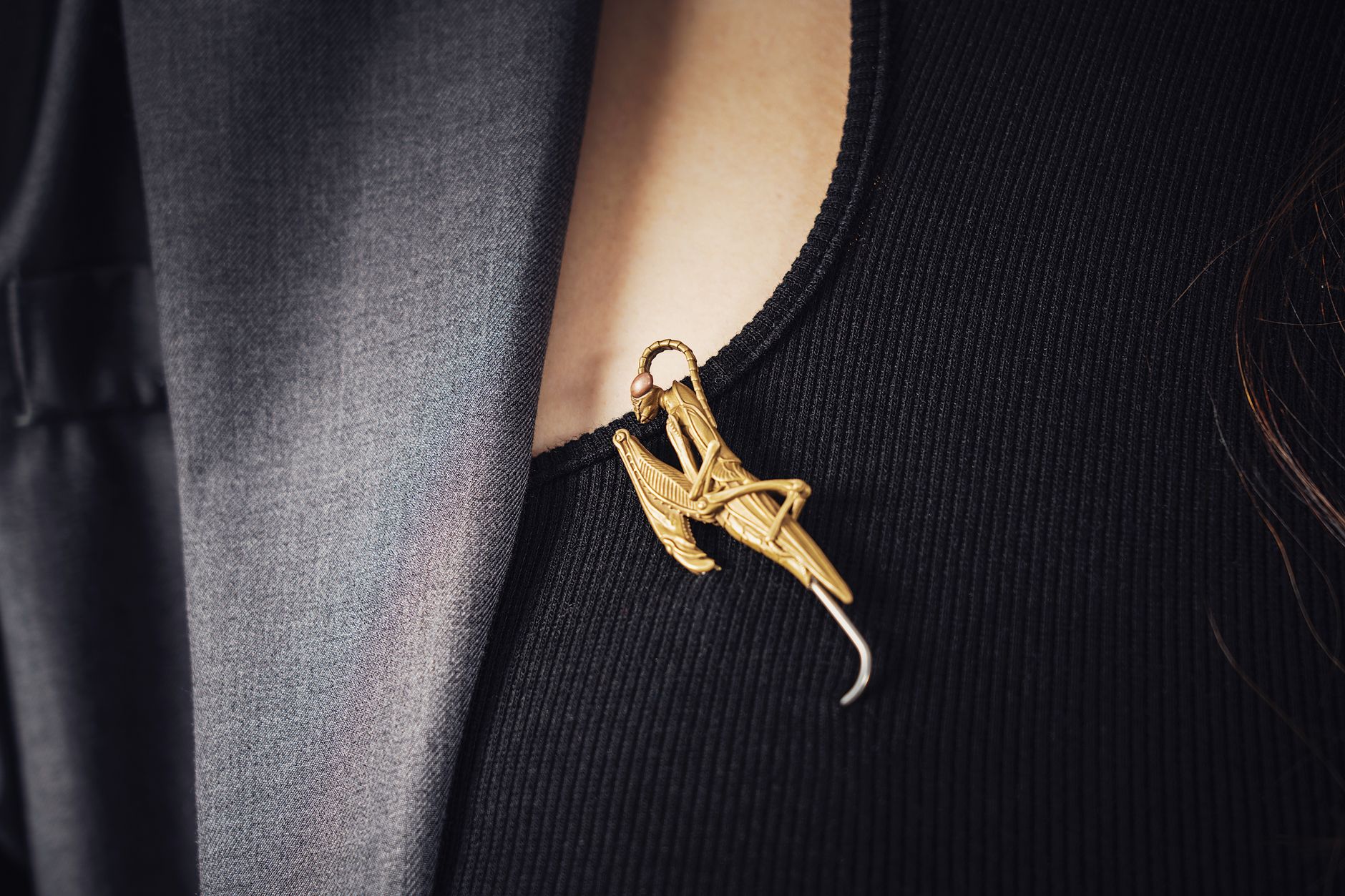
Corsage jewellery from this tradition reads cleanest against plain, structured fabric. A navy blazer, a chalk-stripe suit, a cream linen shirt with a strong collar – these are the backdrops that let the rosette’s geometry do its work without competition. The piece functions like a crest or a badge, which means context matters. Worn on a velvet evening coat, it pulls toward formal. Pinned to a waxed cotton field jacket, it references the country show directly. On a tailored white shirt, particularly at the collar – a space that collar pins have been quietly reclaiming as a jewellery zone – it reads as deliberate and quietly confident.
What this trend resists is casual dressing. The browband rosette carries enough ceremonial weight that it looks incongruous on jersey or denim without significant effort to reframe the whole outfit. This is not a piece that softens or casualises. It elevates, and if the rest of the outfit has nothing to meet it, the rosette simply looks marooned.
Where the Market Is Moving
Independent jewellers with equestrian backgrounds are producing the most considered versions of this trend – small studios where the designer has actual familiarity with the browband rosette as an object, not just as a visual reference pulled from a mood board. These pieces tend to get the proportions right, understand the colour hierarchies, and know which details are load-bearing and which are decoration. The enamel work on the best examples has the same precision as vintage sporting medals, which is the correct aesthetic register.
Larger accessories brands are also moving into this territory, though their versions tend to soften the equestrian reference into something more generically floral. The rosette becomes a stylised bloom rather than a competition award, which broadens the audience but loses the specificity that makes the original reference interesting. Whether that dilution matters depends entirely on what you want the piece to communicate.
The corsage format itself is part of a wider return to pinned accessories – a category that had largely retreated to vintage markets and formal occasion dressing but is now pulling back into everyday tailoring. Brooches, collar pins, lapel badges, and now rosette corsages are all benefiting from the same appetite for accessories that have a fixed position and a clear face, rather than accessories that drape or hang. The rosette, with its built-in pin back and its strong front-facing geometry, fits that appetite precisely. And because its source material – the competitive browband rosette – already exists in a context of display and rank, it carries a legibility that purely decorative jewellery sometimes lacks. You are not just wearing an attractive object. You are wearing something that, in its original form, meant you placed.