

From the Stable to the Seam
Polo saddle girth keepers – the small leather or brass loops that secure a girth strap against a horse’s belly during play – have spent the better part of two centuries doing entirely unglamorous work. They grip, they hold, they disappear beneath a saddle flap without ceremony. Which is exactly why fashion is now obsessed with them. The hardware category that earns zero attention in the tack room is quietly becoming a reference point for trouser waistband construction, specifically the tab-and-loop detail that controls fit at the back of dress trousers and tailored chinos.
The crossover is not accidental. Menswear has been mining equestrian utility dressing for years – bridle leather belts, spur-strap buckles, jodhpur boot silhouettes – but girth keeper hardware represents a more granular level of borrowing. Designers are not simply evoking the polo aesthetic; they are adapting the actual mechanical logic of the keeper to solve a familiar tailoring problem: how do you give a trouser tab real holding power without adding bulk?
What a Girth Keeper Actually Does
To understand the appeal, it helps to know what the original hardware is doing. A saddle girth keeper is a fixed loop, usually sewn or riveted to a leather panel, that threads the loose end of a girth strap back against itself after buckling. Its job is to stop the tail of the strap from flapping free and disturbing the horse or rider. The loop is wide enough to allow movement but tight enough to hold under pressure. That combination – controlled tension with visible security – is precisely what trouser tab hardware has historically failed to deliver well.
Standard trouser tabs typically use a simple bar-and-slot buckle or a sewn elastic loop. Both work, but neither looks like anything worth noticing. The girth keeper model changes that by introducing a double-loop configuration, where the tab passes through one keeper, doubles back, and sits flush against the waistband. The result is a small sculptural detail on the back of a trouser that reads as intentional craft rather than functional afterthought.
How It Translates Into Tailoring
The construction shift is straightforward in theory but demanding in execution. A traditional trouser tab attaches at two fixed points on either side of the back waistband seam and adjusts a single slider. The girth keeper adaptation replaces that slider with a rigid keeper loop – often in brass, gunmetal, or vegetable-tanned leather – and adds a secondary loop to anchor the tab tail. The tab itself is typically cut narrower than a standard version, around twelve to fifteen millimeters, to thread cleanly through both loops without bunching the waistband fabric.
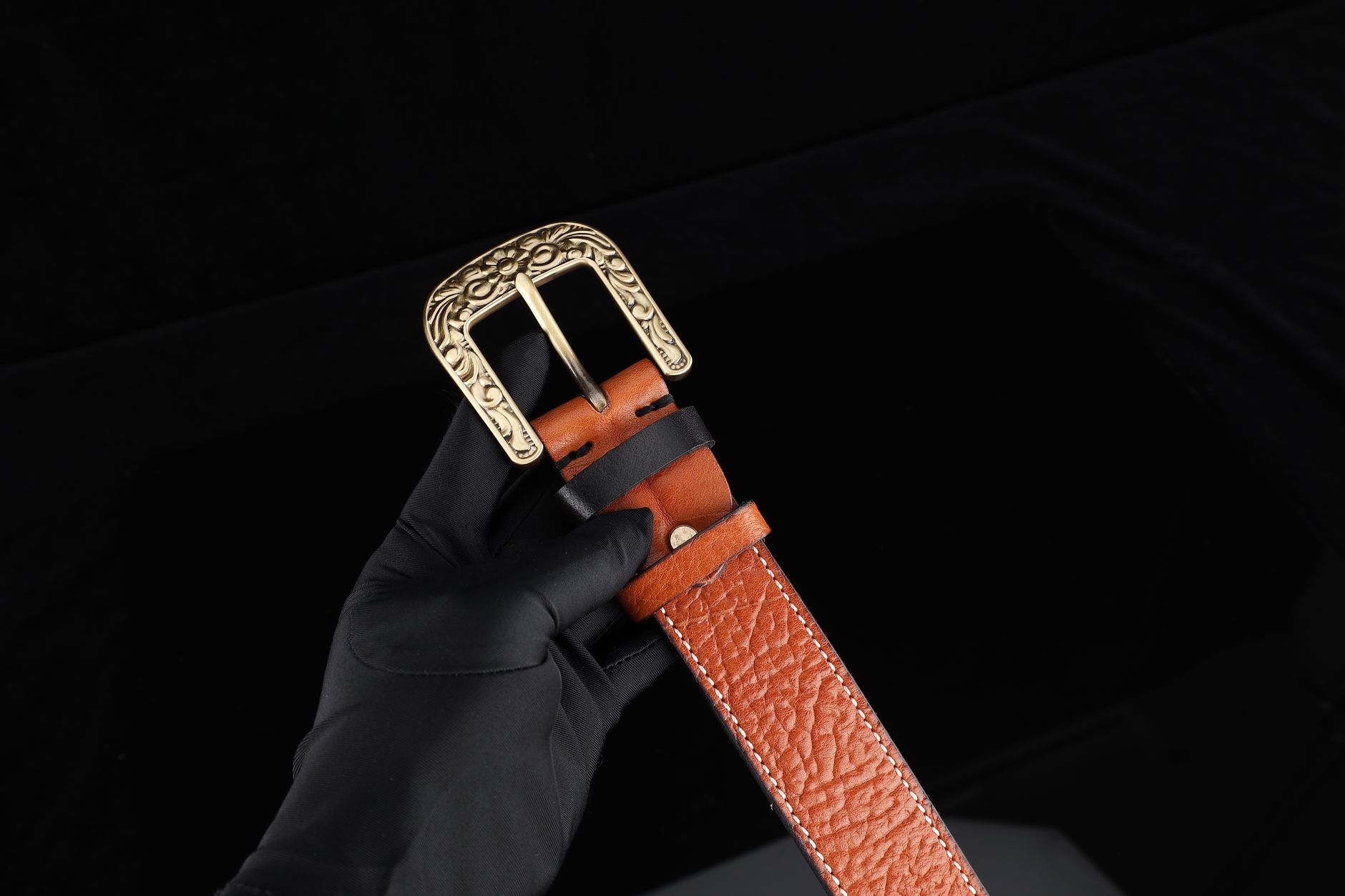
The leather version of this hardware borrows directly from tack-room construction methods. Saddlers burnish the edges of keeper loops and saddle-stitch them to a backing panel, giving the loop rigidity without adding significant weight. When the same method is applied to trouser construction, the keeper sits flat but feels architectural – there is a firmness to it that plastic or folded-fabric tabs simply cannot replicate.
Brass keeper loops bring a different character. Cast or pressed from solid metal, they introduce visible weight and a slight gleam at the back waistband – a detail that only reveals itself when a jacket lifts or a shirt is tucked. Some tailors are treating this as a deliberate surprise: a trouser that looks conventional from the front and reveals its equestrian engineering from behind. The restraint of that placement is part of the point. This is not decorative hardware broadcast across a garment; it is craft detail for the person who leans in to look.
Fabric choices around the keeper also matter. The double-loop system requires the waistband to be reinforced at the attachment points, which is driving a return to canvas-interfaced waistbands in trousers that might otherwise use fusible interlining. That structural demand is pulling construction standards upward in the mid-price range, where girth keeper tabs are appearing most frequently as brands try to separate themselves on detail rather than fabric weight alone.
The Polo Context That Makes It Coherent
Polo dressing has its own long history of crossing from the field into civilian wardrobes – Ralph Lauren built an entire brand identity around that migration. But the current girth keeper moment is less about polo as lifestyle imagery and more about polo as an engineering archive. Tack makers have been solving problems of strap control, tension management, and hardware longevity for over a century, and those solutions were always optimized for performance rather than appearance. That performance logic is exactly what makes the hardware credible when it lands on a trouser.
The credibility is also contextual. Trouser tab hardware exists in a design category adjacent to other equestrian-derived details – the buckle-and-tab systems drawn from sporting breeches that are showing up across tailored trousers right now. The girth keeper sits within that broader conversation, distinct from the knicker buckle aesthetic but connected by the same appetite for waistband hardware with a working-clothing lineage.
Where the Trend Is Heading
The adoption pattern so far favors independent tailors and smaller ready-to-wear labels over large houses. That is partly a production reality – girth keeper tabs require more complex waistband construction than a standard tab, and at volume, the cost difference is difficult to absorb without repositioning the product upward in price. Small-run tailors have no such constraint, which is why the detail is appearing in made-to-measure books and capsule collections before it hits wider retail.
Material exploration is running alongside the silhouette work. Vegetable-tanned leather keepers are aging visibly with wear, developing patina at the wear points the same way a bridle does – which is, for a certain customer, the entire appeal. Brass versions are being deliberately left unlacquered so they oxidize slowly toward a warmer tone. Both choices resist the finished, static look of conventional trouser hardware and instead signal that the detail is meant to be used, not merely displayed.
What is not yet clear is whether the construction logic will hold once larger brands begin scaling it. The double-loop girth keeper works because it is made with the same care as the trouser around it – a mass-market version in lightweight zinc alloy, stitched to a fused waistband with a narrow tab cut from bonded leather, would carry the visual reference while losing everything that makes the hardware function the way it should. The risk is a detail that looks equestrian but moves like a cheap buckle, and that gap between reference and execution is where the credibility of the whole trend will be decided.
Frequently Asked Questions
What is a saddle girth keeper?
A girth keeper is a small fixed loop on a saddle that secures the loose end of a girth strap after buckling, preventing it from flapping during riding.
How does girth keeper hardware work on trousers?
It replaces a standard trouser tab slider with a rigid double-loop system in brass or leather, giving the back waistband a more structured, intentional look and stronger hold.