

The Button Detail That Tailoring Has Always Known
Silk grosgrain buttons have been part of formal menswear for centuries, stitched onto the fronts of morning coats, dress suits, and, most visibly, the tails coats worn by Eton College boys as part of their historic school uniform. The detail was never decorative in the frivolous sense – it was functional formality, a way of finishing a coat front with a material that held its shape, absorbed light rather than reflecting it, and communicated seriousness without ornamentation. That same logic is now pulling the detail into a very different wardrobe context.
A growing number of contemporary tailoring labels are specifying silk grosgrain for button facings on minimalist blazers – not as a nod to tradition for tradition’s sake, but because the material solves a specific visual problem that plastic and resin buttons cannot.
The problem is contrast without noise.
Why Grosgrain Works Where Other Materials Fall Short
A standard blazer button in resin or horn catches light at unpredictable angles. On a clean, unfussy front – the kind of single-breasted, notch-lapel silhouette that has anchored minimal dressing for the past several seasons – that unpredictability reads as clutter. The eye keeps snagging on the buttons when the intention of the garment is to move past them. Silk grosgrain, with its tight horizontal ribbing and matte finish, absorbs light evenly. The buttons register as present without competing for attention. They sit in place rather than catching the eye.
The ribbed texture of grosgrain also creates a tactile contrast against smooth wool, fine twill, or brushed cotton – the fabrics most commonly used in the kind of unlined, relaxed-shoulder blazers that define the current moment in tailoring. That contrast is felt as much as seen. A button that feels different from the cloth it fastens adds a quiet layer of material intelligence to a garment, the kind of detail that communicates craft without requiring explanation. Designers working in this register tend to treat buttons the way architects treat door hardware: the object should be resolved, not decorative.
The Eton connection matters because the school uniform is one of the few contexts in modern dress where silk grosgrain buttons have remained entirely unchanged for generations. The tails coat worn by Eton boys – that distinctive formal silhouette with its long back panels and short front – has been fastened with those same ribbed buttons without revision. The continuity is not nostalgia. It is evidence that the material works, that it wears without distortion, and that it ages in a way that improves rather than degrades the look of the garment. Contemporary tailors are drawing on exactly that track record.
How the Detail Translates Across Modern Tailoring
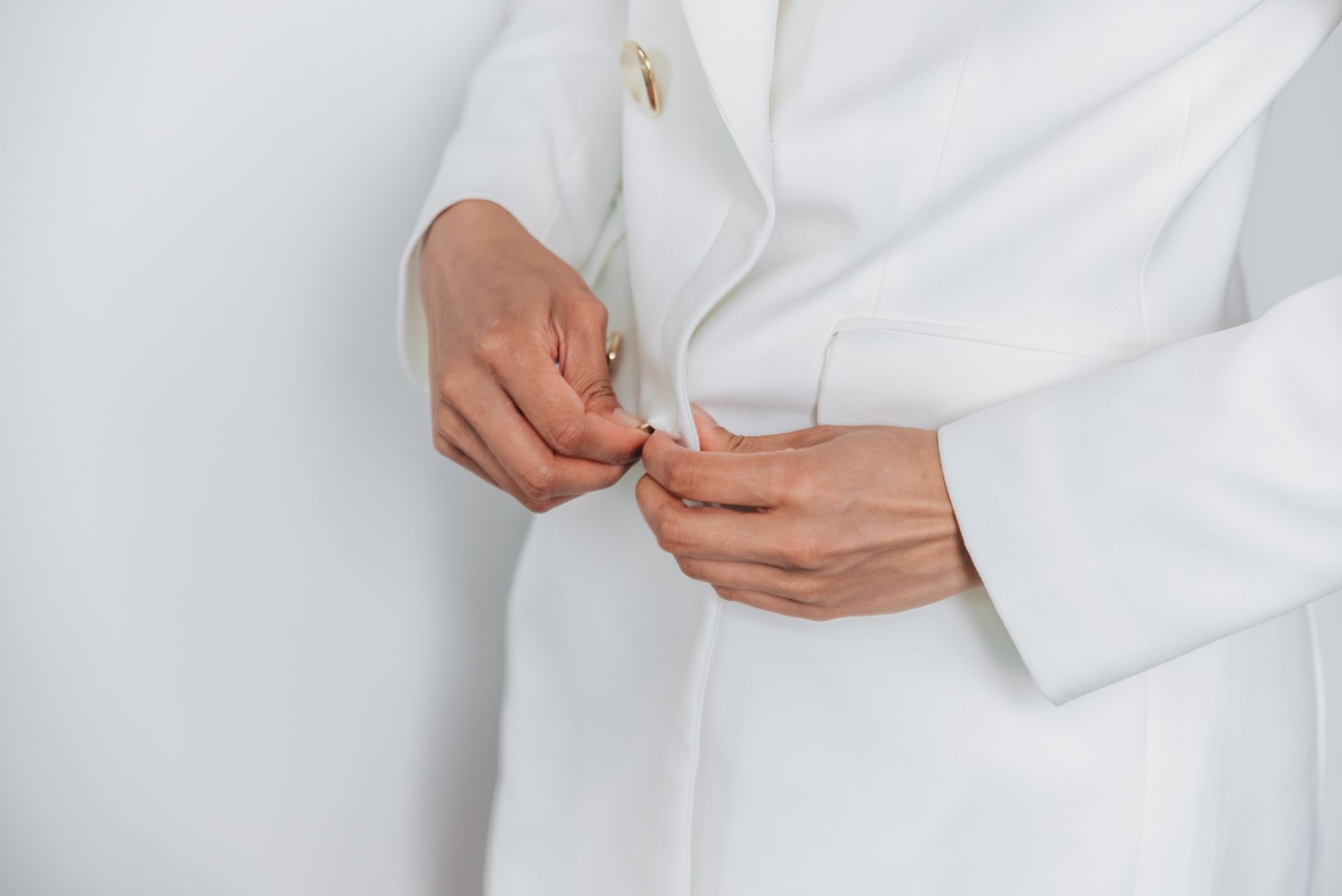
The application is not literal. No one working in this space is building blazers that reference the silhouette of a tails coat. The transfer is purely material – the button construction migrating from one context into another. A single-breasted blazer in oatmeal wool with two-button fastening, specified in silk grosgrain, carries none of the ceremony of formal schoolwear. What it carries is the same quality of surface quiet. The front reads as resolved. Nothing is asking for attention. That restraint is now the point.
Some brands are experimenting with tonal grosgrain – matching the button color closely but not exactly to the jacket fabric, so the buttons read as a slightly different value of the same hue rather than a sharp contrast. This approach pushes the detail even further into the background while still providing the structural clarity that a flat-front jacket requires. Other approaches use black grosgrain on dark navy or charcoal as a way of adding depth without introducing a new color to the palette. The effect is similar to how a welt stitch at a sleeve hem creates definition without decoration – the detail is load-bearing in a visual sense without announcing itself.
The shift also reflects something specific about how minimalist tailoring is being evaluated right now. When a garment has no pattern, no visible lining, no pocket square, and a clean unstructured shoulder, the quality of every remaining element is exposed. There is nowhere for a mediocre button to hide. Grosgrain, with its material history and its particular surface behavior, holds up to that scrutiny in a way that cheaper alternatives do not. It reads as a considered choice rather than a default one.
The Quiet Authority of an Overlooked Detail
What the Eton tails coat ultimately offers to contemporary tailoring is not a silhouette or a mood but a proof of concept: that the right button material, held constant across decades of wear and variation, remains exactly right – and that silk grosgrain’s particular combination of texture, matte finish, and quiet formality is as capable of anchoring a stripped-back blazer front today as it was the first time it was sewn onto a schoolboy’s coat.